

Whether this is your first sundew or you’ve had trouble keeping them alive in the past (no judgment here), you’ve come to the right place. This guide will teach you how to care for sundews, from how much sunlight they require to the insects they like to eat.
I’ve been caring for carnivorous plants for over 10 years, including sundews and Venus flytraps, so I’m happy to share what I’ve learned with you from trial and error and my own research (forums, carnivorous plant Facebook groups, and articles online).
The good news is that sundew plant care isn’t as complicated as it might seem. Carnivorous plants have a reputation for being notoriously hard to keep alive, but I don’t agree. All it takes is a willingness to learn about their proper care — including your plant’s species and specific needs — and you (and your plant) will be good to go.
What Are Sundew Plants?

Sundews, or Drosera, are a type of carnivorous plant known for their unique way of catching prey. The name “sundew” originates from the shiny, dew-like substance that covers the plant’s leaves, which glistens in the sun and attracts unsuspecting insects.
These fascinating (and cute!) carnivorous plants are found worldwide — from the United States to Africa — but most of the species call Australia home. They thrive in poor, acidic soil where they cannot get enough nutrients, so a carnivorous lifestyle is a must to keep them healthy.
Carnivorous sundew plants have small, tentacle-like structures on their leaves that produce a sticky substance. This substance attracts insects with its sweet scent and traps them once they land on the leaf. The plant then uses enzymes to digest the insects, absorbing nutrients such as nitrogen and phosphorus, which are scarce in their natural habitat.
Below, you can see my sundew with gnats all over its tentacles. The tentacles will curl over the bug to “eat” it.
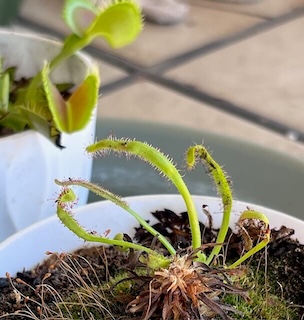
Most sundews produce a flower stalk, which looks pretty and can lead to sundew babies. Otherwise, you can cut the flower stalk off when it grows.
What Sundew Plants Are Best for Beginners?

For beginners interested in growing sundews, the Drosera capensis or Cape sundew (I have two Cape sundews) is a great place to start.
It’s an easy-to-care-for plant that adapts well to various conditions — so you should be able to keep it alive no matter where you live. The Drosera spatulata and Spoon-leaved sundew are also excellent choices for beginners — both plants are resilient and easy to grow.
Types of Sundews (and Where They Grow Best)

There are at least 194 sundew species, which means you have plenty of types to choose from for your next plant.
Not sure which sundew plant you should get? The right plant will depend on where you live. Luckily, there is a sundew for almost every climate.
Temperate Sundews: Best for Regions With Distinct Seasons

Temperate sundews thrive in climates that experience both warm summers and cool winters. The sundews below are excellent choices if you reside in an area with distinct seasonal changes.
Types:
- Drosera rotundifolia (Round-leaved Sundew)
- Drosera intermedia (Spatulate-leaved Sundew)
Ideal States:
- Northern and central parts of the United States, such as New York and Ohio, where seasons transition clearly
Tropical Sundews: Best for Warm, Humid Regions
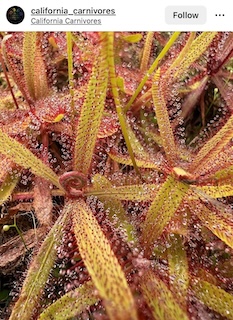
Tropical sundews will feel right at home if you’re in a warm and humid climate. These varieties flourish in consistently high temperatures and humidity levels, mimicking their native tropical plant habitats.
Consider the plants below if your region offers a balmy environment, perhaps with a bit of extra humidity to replicate the conditions they love.
Types:
- Drosera capensis (Cape Sundew)
- Drosera adelae ( Lance-leaved Sundew)
Ideal States
- Florida
- Texas
- (And other southern states with warm temperatures and high humidity)
Note: While sundews have preferred habitats, they are generally quite adaptable and can thrive in a variety of environments given the right care. For example, I live in Phoenix, Arizona, which is notoriously dry, but my Drosera capensis plants are doing great.
Tuberous Sundews: Best for Regions With Dry Summers or Harsh Conditions

Tuberous sundews, with their underground tubers, are well-suited for regions with dry summers or challenging conditions. These adaptations allow them to endure periods of environmental stress, making them a resilient choice for enthusiasts in areas with less consistent humidity or water availability.
Types:
- Drosera erythrorhiza (Variable-leaf Sundew)
- Drosera auriculata (North West Tuberous Sundew)
Ideal States:
- Arid regions like Arizona or Nevada
Pygmy Sundews: Best for Small Spaces or Indoor Cultivation

Source: HobbyTavor
Pygmy sundews, owed to their diminutive size, are ideal for enthusiasts with limited space or those cultivating plants grown indoors only. They thrive in nutrient-poor environments and are well-suited to be potted plants or live in terrariums.
Types:
- Drosera scorpioides (Spatulate-leaved Pygmy Sundew)
- Drosera pulchella (Purple Pygmy Sundew)
Ideal States:
Anywhere, but particularly suitable for urban environments or indoor cultivation
Understanding Sundew Anatomy

Now that you know your adelae from your auriculata, let’s dive into the anatomy of sundews, which we already touched on a bit above.
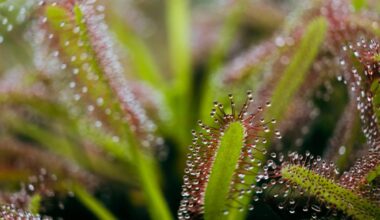
Sundew leaves are covered with minute, hair-like projections called tentacles. Each of these tentacles is capped with a gland that secretes a sticky, dew-like substance. As a carnivorous plant, this substance serves a dual purpose: it lures insects with its sweet scent and ensnares them once they land on the leaf.
Upon contact with the prey, the tentacles exhibiting thigmotropism, a movement in response to touch, slowly curl around the trapped insect.
The plant then secretes digestive enzymes that decompose the insect, enabling the plant to absorb essential nutrients such as nitrogen and phosphorus. Sundews also produce delicate flowers, typically in hues of pink or white.
How to Care for a Sundew Plant

Whether you have a Drosera capensis or pygmy sundew, each type has its unique care requirements.
Adjust your approach based on factors like temperature, light preferences, and specific soil compositions for a flourishing sundew collection.
Sundew Light Requirements
Sundew plants are lovers of light. They require substantial sunlight to thrive and exhibit their unique insect-trapping mechanism.
Ideally, sundews should get at least six to eight hours of direct sunlight per day.
If you’re growing sundew plants indoors, placing them near a south-facing window with plenty of sunlight is a good option. However, you can supplement natural light with artificial light sources if a sunny window isn’t available. Fluorescent lights, specifically those designed for plant growth, can provide the necessary light intensity for sundews.
When using artificial lights, ensure the light source is placed close to the plants, ideally no more than a few inches away. This is because light intensity decreases rapidly as the distance from the light source increases. (I use a grow light for my Drosera capensis and it’s doing well with it.)
Remember, light is important for the plant’s photosynthesis and influences the production of the sticky, dew-like substance essential for the plant’s carnivorous nature.
However, every rule has its exceptions, and in the world of sundews, that is the Drosera adelae. Unlike its sun-loving counterparts, Drosera adelae performs better in bright indirect light. If you have this carnivorous plant in your collection, be mindful of providing the right balance of light to keep it thriving.
Sundew Water Requirements

Sundew plants, being carnivorous, have specific water requirements that set them apart from most other species of houseplants.
Here are the basics of how to properly water your sundew:
- Quality of water: Sundews are sensitive to the minerals found in most tap water. Use distilled water, rainwater, or reverse osmosis water for these plants.
- Watering method: The preferred way to water sundews is the tray method. This involves placing the plant pot in a tray or saucer and filling it with about half an inch of water (or no more than 1/3 of the pot). This allows the plant to draw up water from the bottom, ensuring the roots are always moist. If your plant is outdoors in winter, consider top watering to avoid soggy soil.
- Frequency of watering: The frequency of watering depends on the tray’s size and the evaporation rate. However, a general rule is to refill the tray once the water has almost completely evaporated.
- Humidity preferences: Sundews thrive in high humidity, so regular misting can help meet their water needs. However, this should not replace the tray watering method but should be used in conjunction.
- Seasonal changes: During winter, some sundews enter a dormancy period and require less water. Reduce watering during this period, but ensure the soil does not completely dry out.
- Overwatering: While sundews love water, they can still be overwatered if they sit in too much water. If the plant starts to look yellow or unhealthy, consider reducing the amount of water in the tray.
Sundew Soil Requirements
Sundew plants need different soil than your average houseplant. Understanding these requirements is critical to successfully growing them in your home or garden.
Here are the basics:
- Soil mixture: Sundews thrive in nutrient-poor, acidic soils. A common mix is a blend of sphagnum peat moss and sand or perlite. The sphagnum peat moss is acidic and low in nutrients, which mimics the natural conditions in which these plants grow. The sand or perlite helps to improve drainage and prevent the soil from becoming too waterlogged.
- Soil pH: The ideal pH for sundews is around 4.5 to 5.5, which is quite acidic. You can use a pH tester to check the acidity of your soil and adjust it as necessary.
- Drainage: While sundews love water, they do not like to be waterlogged. This is why the soil you use must provide excellent drainage. Adding sand or perlite to your soil mix can help with this.
- Nutrient content: Sundews are adapted to grow in nutrient-poor soils and don’t require any additional fertilization. In fact, adding fertilizer to your sundew’s soil can harm or even kill it.
- Repotting: Sundews do not have a large root system, and don’t require frequent repotting. However, if you do need to repot your sundew, it’s best to do so in the spring or early summer. When repotting, use fresh peat moss and sand or perlite, and avoid compacting the soil too much.
- Soil depth: A pot depth of around 4-6 inches is usually sufficient for most sundew species. The pot should be deep enough to allow the roots to spread out but not so deep that water sits at the bottom and causes the roots to rot.
Remember that sundew plants require different soil than your standard houseplant. If you use potting soil from Home Depot or even dirt or soil from your yard, your sundew might die.
Why?
Because they need soil that mimics what’s in their natural habitat — devoid of nutrients, acidic, and able to retain moisture.
The go-to combination is pure sphagnum moss paired with an equal amount of silica sand (not beach, river, or “play” sand) and/or perlite.
Sundew Fertilizer Requirements
Unlike most plants, sundews do not benefit from conventional plant fertilizers. These fertilizers can actually harm your plant by causing fertilizer burn or nutrient overload.
This is because sundews are adapted to low-nutrient environments and can be overwhelmed by the high nutrient content in many fertilizers.
How to Feed Sundew Plants

Feeding your carnivorous plant is an interesting and unique process. Unlike most plants, sundews derive their nutrients primarily from the insects they capture.
Here’s a detailed guide on how to feed your Sundew plant:
Frequency of Feeding
Sundews don’t need to eat daily. In fact, feeding your sundew too frequently can cause the plant’s leaves to blacken and die. While sundews are pretty good at catching food on their own (especially if they live outdoors), you can feed them if they’re struggling.
A good rule of thumb is to feed your sundew every two to three weeks.
Note: Ensure the insects or fish food flakes you feed your sundew are small enough to fit comfortably on the leaf. Food or insects that are too large can weigh down the leaf and may cause it to blacken and die.
Insects
Sundews are not particularly picky eaters when it comes to insects. They will happily consume any small insect that lands on their sticky leaves.
You can see one of my sundews here with gants on its tentacles.

Sundews like the following insects:
- Flies
- Moths
- Fungus gnats (sundews are AMAZING at handling gnat issues indoors)
- Mosquitoes
- Small beetles
- Ants
If your sundew is grown indoors and doesn’t have access to a steady supply of insects, you can supplement its diet.
Fish Food
An alternative to feeding your sundew plant insects is to use fish food flakes. These are readily available at pet stores and can be an easy solution if you don’t have access to suitable insects.
To feed your sundew fish food flakes, lightly mist the plant with distilled water. Then, using tweezers, place a small flake onto the sticky dew on one of the leaves. The plant will do the rest, curling its leaves around the food to begin the digestion process.
I feed my sundew fish food sometimes, and it’s fun and fascinating to see. I highly recommend trying it out even if you don’t plan to feed them this way regularly.
It only takes my sundew a couple of hours before it curls around a fish flake (I only put one tiny flake on a tentacle) and probably about six to seven hours before the fish flake is digested.
If you put too many flakes on your sundew or too big of a flake, they may be unable to digest them and cause the flakes to rot.
Maxsea
Maxsea is a seaweed-based fertilizer (don’t use regular fertilizers) often used to feed carnivorous plants like sundews. It’s rich in essential nutrients and can help promote healthy growth and vibrant color in your plants.
Here’s how you can use Maxsea to feed your sundews:
- Prepare the Maxsea solution: Dissolve a small amount of Maxsea fertilizer (about 1/4 teaspoon) in a liter of distilled water.
- Spray the solution: Use a spray bottle to lightly mist your sundews with the Maxsea solution. Aim to cover the entire plant surface, focusing particularly on the tentacle-covered leaves where the plant absorbs nutrients.
- Monitor your plants: Keep an eye on your sundews after feeding them with Maxsea. If they respond well, you’ll likely see more vibrant coloration and healthier growth. If they seem to be struggling, cut back on the frequency or concentration of the Maxsea solution.
How to Care for Sundews in Winter

Sundew plants, like many carnivorous plants, have different winter care requirements based on their species and natural habitats. Some sundews require a period of winter dormancy, while others do not.
Understanding the specific needs of your sundew type is crucial for its survival and growth during the colder months.
Sundews That Require Winter Dormancy
Like Venus flytrap dormancy, some temperate sundews require a period of dormancy in winter. This dormant period mimics their natural habitats’ cold, less active winter months.
During dormancy, these sundews will appear to die back, with leaves wilting and turning brown. However, this is a natural process (they’re not dead!), and the plant is simply conserving energy during the colder, less productive months.
These sundews require dormancy:
- Drosera rotundifolia (Round-Leaved sundew)
- Drosera anglica (English sundew)
- Drosera filiformis (Thread-Leaved sundew)
- Drosera intermedia (Oblong-Leaved sundew)
How to Care for Dormant Plants:
- Reduce watering: While sundews still need to be kept moist during dormancy, they require less water than in their active growth period. Reduce watering but ensure the soil remains damp. I only top water during winter dormancy to ensure the plant doesn’t get root rot since the weather is chilly. Resume bottom watering once dormancy is over in early spring.
- Provide cooler temperatures: Try to mimic the plant’s natural winter environment by providing cooler temperatures, ideally between 35-40 degrees Fahrenheit. If your plant is indoors, move it to an unheated room, like a garage or shed.
- Avoid feeding: Do not feed insects to your sundew during dormancy. The plant is not actively growing and cannot properly digest the food.
Sundews Not Requiring Winter Dormancy
Tropical sundew species do not require a period of dormancy. However, they may still go dormant if exposed to winter weather.
These sundews continue to grow and catch insects throughout the winter months:
- Drosera capensis (Cape sundew)
- Drosera spatulata (Spoon-Leaved sundew)
- Drosera aliciae (Alice sundew)
- Drosera binata (Fork-Leaved sundew)
- Drosera adelae (Lance-Leaved sundew)
How to Care for Non-Dormant Sundews During Winter
- Maintain watering: Continue to keep the soil moist and water like normal if your plants are indoors. If outdoors, consider top watering and only water when the soil gets dry.
- Provide sufficient light: As these sundews grow during winter, they still require plenty of light. If natural light is insufficient due to shorter winter days, use a grow light.
- Keep warm: Tropical sundews prefer warmer temperatures, so try to maintain an environment above 60 degrees Fahrenheit. If exposed to chillier weather, the plants may go dormant.
- Continue feeding: Since they remain active, these sundews can continue to be fed insects during winter.
How to Propagate Sundews

Propagating sundews, like many other carnivorous plants, can be an exciting and rewarding endeavor. There are several methods to propagate sundews, each with its own set of steps and considerations.
Here’s a look at the most common methods:
Leaf Cuttings
This technique works well with most Drosera but not all. Avoid using it for tuberous and pygmy sundew propagation.
- Step 1: Select healthy leaf cuttings from your sundew plant and cut them off as close to the base as possible.
- Step 2: Place each leaf on a moist mixture of moss (sphagnum) and perlite.
- Step 3: Ensure each leaf is in a location with plenty of indirect light and high humidity, which can be achieved by covering it with a clear plastic bag.
- Step 4: After a few weeks, small plantlets will form at the edge of each leaf. Once these plantlets have grown a few leaves, they can be repotted.
- Step 5: Continue to provide them with high humidity, plenty of light, and regular watering with distilled water or rainwater.
Seed Propagation
- Step 1: Harvest mature seeds from the flowers of your sundew plant.
- Step 2: Sprinkle the seeds lightly on top of a mixture of moss (sphagnum) and perlite.
- Step 3: Keep the soil moist and place the pot in a location with plenty of indirect light.
- Step 4: Seeds should germinate in a few weeks, depending on the species.
- Step 5: Once the seedlings have grown a few leaves and are big enough to handle, they can be carefully transplanted into their own pots.
Root Cuttings
- Step 1: Carefully uproot your sundew plant and cut a piece from the root.
- Step 2: Bury the root cutting in a pot filled with a mixture of moss (sphagnum) and perlite.
- Step 3: Keep the soil moist and place the pot in a location with plenty of indirect light.
- Step 4: After a few weeks, new shoots should emerge from the soil.
- Step 5: Once these shoots have grown a few leaves, they can be repotted.
Flower Stalk Cuttings
- Step 1: Cut a section of the flower stalk from your sundew plant.
- Step 2: Lay this section on the surface of a pot filled with moss (sphagnum) and perlite.
- Step 3: Keep the soil moist and place the pot in a location with plenty of indirect light.
- Step 4: After a few weeks, new plantlets should form along the flower stalk.
- Step 5: Once these plantlets have grown a few leaves, they can be repotted.
Potential Sundew Plant Problems

It ain’t easy being carnivorous. While some of the coolest and cutest pants around, sundews are not without their challenges.
However, don’t let this discourage you from owning one. I find that, like any houseplant, you can keep them alive by spending a little time learning about their care (like you’re doing right now!).
Pests
Sundew plants can attract certain pests, such as aphids and spider mites. Aphids can be identified by their small, pear-shaped bodies and tendency to cluster on new growth. Spider mites, on the other hand, are tiny and often invisible to the naked eye, but they can be detected by the fine, silken webbing they leave on the plant.
Solution: You can use a gentle insecticidal soap or a neem oil solution to combat these pests. Spray it on the affected areas, careful not to oversaturate the plant. Repeat this process every few days until the infestation is under control.
Overwatering
While sundews enjoy moist conditions, overwatering can lead to root rot. Signs of overwatering include yellowing leaves and a general decline in the plant’s health.
Solution: I bottom water my sundews, which works perfectly, but aim to keep the water no higher than 1/3 of the pot. If your pot is fully immersed or the water is up to its “waist,” this can cause issues. Top water in winter, when they will stay moist longer and will naturally not need as much watering.
Fungal Infections
Fungal infections can occur if your sundew is kept in conditions that are too damp or humid without enough air circulation. Signs of a fungal infection include discolored patches on the leaves or a powdery white substance on the plant.
Solution: To treat a fungal infection, remove the affected leaves and treat the plant with a fungicide.
Too Much Sun
While sundews enjoy plenty of light, too much direct sunlight can scorch their leaves, leading to a burned or bleached appearance. If you notice your sundew’s leaves turning red or brown, it might be receiving too much light.
Solution: I live in Phoenix, Arizona, where it’s easy for even the most sun-loving plants to get too much sun during the hottest months of the year. As a result, I bring my carnivorous plants indoors during the summer months and supplement with a grow light. Depending on where you live, you might want to do this too. Alternatively, place your sundew in a location where it will receive bright but indirect light.
“Dew” You Understand Sundew Care Now?

Now that you know how to care for a sundew plant, from Drosera capensis to Drosera spatulata, I hope you give this carnivorous plant a try.
While I find Cape sundews to be great for beginners, choose the species you like and give it a go. With a little research and diligent care, your plants should thrive year-round.
Frequently Asked Questions
How do you care for indoor sundews?
Indoor sundews thrive in bright light. Aim for six to eight hours of sunlight per day in a sunny windowsill or with a grow light. Water them with distilled water or rainwater (not tap water) so they’re moist at all times. Ensure your sundew has access to insects or supplement feeding with fish food.
Are sundews hard to care for?
Sundews, while not overly complex to maintain, do have some unique requirements that set them apart from your average houseplant. They require six to eight hours of sunlight per day, and some species thrive in higher humidity environments. Additionally, their diet consists of insects, which they trap and digest using their sticky tentacles. If you prefer to keep your sundew indoors, you can feed it with fish food. With the correct care and attention, sundews can flourish both indoors and outdoors, making them a fascinating addition to any plant collection.
How often do sundews need to eat?
Sundews need to eat every two to three weeks. They can survive quite healthily on a diet of a few insects per month. It’s important to note that overfeeding can actually harm these plants. The digestion process takes energy, and too much prey can lead to exhaustion. Therefore, it’s advisable to err on the side of caution and not overfeed your sundew.
Can sundews eat dead bugs?
Sundews are capable of consuming dead insects. However, they do have a preference for live prey. The reason behind this is the movement of the live insect. When an insect struggles on the sticky tentacles of the sundew, it triggers the plant to produce more digestive enzymes. These enzymes help break down the insect, allowing the plant to absorb the nutrients. While dead insects can still provide some nourishment, the lack of movement means less enzyme production and less nutrient absorption.




7 comments
Comments are closed.