
The Cape sundew (Drosera capensis) is a carnivorous plant with pretty pink/red tentacles. Cape sundews are a perfect option for beginners because they’re easy to keep alive — even if you don’t think you have a green thumb.
Note: If you’re looking for a general care guide, learn how to care for sundews here, including soil, water, and food requirements.
Want to know how to care for Drosera capensis specifically? Keep reading for everything you need to know.
Scrappy Gardeners is reader-supported. As an Amazon Associate, we earn from qualifying purchases when you click on links in this post.
What Is a Cape Sundew?

A Cape sundew is a perennial, carnivorous plant from the Cape region of South Africa. Its natural habitat is marshy areas with acidic soil, so anyone looking to grow these plants should mimic its preferred conditions.
These plants grow best in Zones 7 to 9 and thrive when kept warm, moist, and humid.
Cape sundews have long, narrow leaves covered in bright red tentacles. These tentacles exude a sticky, sweet-smelling secretion known as mucilage, which glows like morning dew under the sunlight, thus earning the plant its ‘sundew’ moniker.
But this ain’t your grandma’s dew. The sundew’s mucilage is a deadly trap. Drawn by its sweet scent, unsuspecting insects land on the plant’s leaves and find themselves stuck.
Once prey is stuck in its tentacles, the leaf will slowly wrap around the trapped insect, and it will secrete digestive enzymes. The nutrients obtained from this process supplement the poor nutrient content of the soil in which Cape sundews typically grow.
How Big Do Drosera Capensis Get?

Typically, mature Cape sundews can reach 6 to 8 inches. The plant’s leaves can reach 2.5 to 3 inches in length at maturity. But this can vary depending on its care and environment. However, it’s important to note that this carnivorous plant is recognized for its robust growth and can become quite large compared to other sundews.
Here’s one of my larger sundews that has multiplied and gotten pretty tall!

There’s also a variety known as ‘Big Pink’ that has a leaf span of 6 inches and often grows to 6 inches tall. This variety is known for its pink coloration when exposed to high-intensity light and for growing much larger than the average Cape.
As for the sundew’s flowers, they bloom on stalks that can reach up to 12 inches tall.
Do Cape Sundews Have a Dormancy Period?

Drosera capensis are native to South Africa, a region with a climate that doesn’t experience harsh winters. So, unlike some other carnivorous plants, they do not require a dormancy period. They can grow continuously throughout the year if given sufficient light and warmth.
However, they can tolerate a period of reduced growth if conditions become less favorable, such as cooler temperatures or shorter daylight hours. This is not a true dormancy but rather a response to environmental changes. Once conditions improve, they will resume their normal growth,
It’s important to note that while they don’t need a dormancy period, they can benefit from a rest period during winter. Reduce watering slightly during this time, but never let the plant dry out completely.
What Do Cape Sundews Eat?
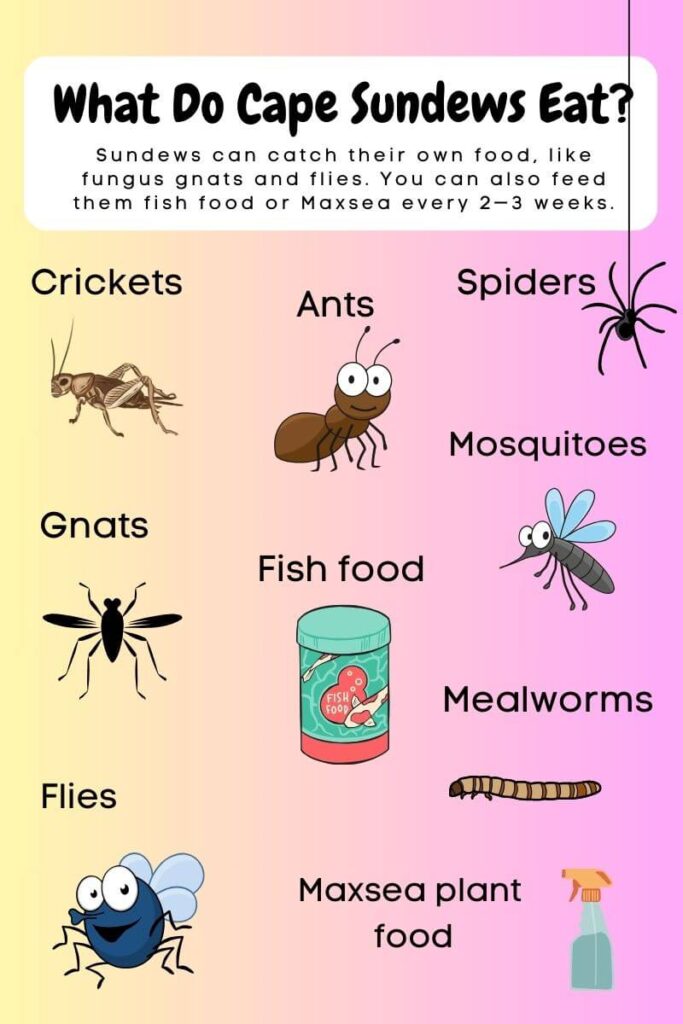
Drosera capensis are carnivorous plants that consume a variety of small insects, but you can also feed them other things, like fish flakes and Maxsea, to supplement thier diet. Or you can help your plant catch bugs like I do.
Since I keep my sundew inside during the summer, it only catches the occasional insect on its own. So, every few weeks, I’ll put it outside at night underneath the porch light or a grow light to attract bugs. And it typically catches more than a few insects this way.
This is an easy way to make sure it eats enough while keeping it out of the heat (I live in Arizona, so our climate doesn’t work for these plants year-round).
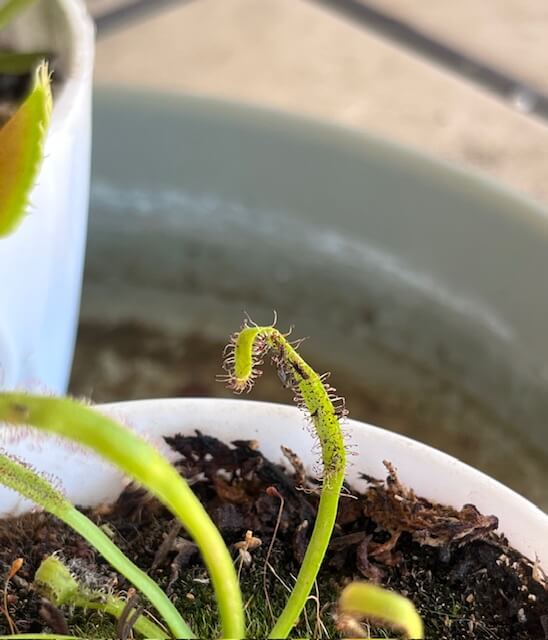
However, I keep my plants outside full-time in spring and late fall, and you can see in the picture below that it isn’t lacking for bugs — its tentacles are littered with gnats.
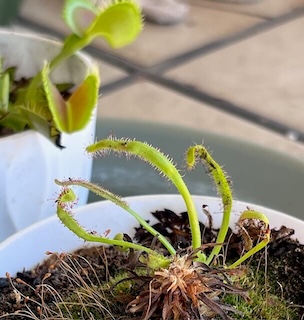
It’s really fun to feed these plants, though, so experiment with a variety of food sources below to see what your plant likes best.
The sundew diet can include the following:
- Fruit flies
- Fungus gnats
- Moths
- Beetles
- Spiders
- Ants
- Crickets
- Mosquitoes
- Beta fish food pellets (crushed)
- Fish food flakes
- Freeze-dried or frozen bloodworms
- Maxsea fertilizer
How Often Do You Feed a Cape Sundew?

You can feed your Drosera capensis every two to three weeks. While feeding these plants is fun, be careful not to overfeed. Sundews don’t require daily food like humans — they absorb energy from the sun, and insects are just a supplemental nutrient source for these plants.
Remember that these plants can catch their own food, from fruit flies to gnats. If they’re kept outdoors or have access to insects, they might not need supplemental feeding at all.
Always observe the health of your plant and adjust care as needed. For example, if your plant seems to be struggling, you may need to feed it more frequently. But if it’s still digesting a previous meal, it’s best to skip feeding.
How to Feed a Cape Sundew

Feeding your Drosera capensis is a fun and interesting process. If your plant isn’t able to catch prey on its own, you can supplement with fish flakes or Maxsea for optimal growth and health. I linked the products I use. My indoor sundew tends to catch more bugs than I’d expect on its own, so I don’t have to supplement too often.
In ideal conditions, sundews get energy from the sun, and eat insects only for supplemental nutrients. So, you won’t ever need to feed your sundew daily or even weekly.
Limit feedings to no more than every two to three weeks. Some sundew owners only feed their plants every couple of months or even just twice a year. Experiment with feeding frequency to see what your plant likes best.
Here’s how to feed a Drosera capensis:
- Choose the food: Suitable food options can include betta fish food pellets, freeze-dried or frozen bloodworms or mealworms, and small insects like gnats or ants. The food should be about 1/3 the size of the leaf you’re feeding to avoid overwhelming the plant.
- Prepare the food: If you’re using dried bloodworms, rehydrate them with a bit of water before feeding them to your plant. This makes it easier for the plant to digest.
- Place the food on a tentacle: Using tweezers, carefully place the food onto the plant’s tentacles. The sticky “dew” will begin to envelop the food. Eventually, the leaf slowly curls around its prey to start digestion. If you’re feeding Maxsea, mix 1/4 teaspoon in 1 gallon of water and pour some into a spray bottle (a misting bottle works best). Then, lightly mist your plant with the mixture.
- Wait for digestion to occur: Once the food is trapped, the plant will start to secrete digestive enzymes to break down the food. This can take anywhere from a few hours to a few days, depending on the size of the food.
How Do Cape Sundews Digest Prey?

Drosera capensis have a fascinating method of capturing and digesting their prey. The plant’s leaves are covered in long, thin tentacles tipped with a sweet, sticky substance or “dew.” When a small insect lands on a leaf, it becomes stuck to the dew. The struggle of the trapped insect triggers the plant’s tentacles to slowly bend toward the insect, further ensnaring it in the sticky mucilage.
Once the insect is firmly trapped, the plant begins the digestion process. It secretes digestive enzymes from its tentacles that break down the soft tissues of the insect. This process can take anywhere from a few hours to several days, depending on the size of the insect.
The nutrients are absorbed through the leaf surface, providing the plant with essential nutrients such as nitrogen and phosphorus, which are often scarce in the soils where these plants naturally grow.
After the digestion process is complete, the leaf will slowly uncurl and return to its original position, ready to capture its next meal.
The process is the same with fish flakes and Maxsea. However, the first time I put one tiny fish flake on a tentacle, it was gone within five hours or so! It was amazing to see how quickly it digested it.
If you notice food that’s been sitting on your plant for a while, it’s best to try to remove it with a toothpick without harming the plant. For example, my Drosera capensis caught a tiny spider when it was outside for the day, but it still hasn’t digested it, and it’s been a few days.
I’ll try to remove the spider if it still hasn’t digested it within a few more days to ensure it doesn’t get moldy.
Cape Sundew Care Requirements

Caring for a Drosera capensis involves providing the right amount of light, water, soil, and maintaining an appropriate temperature and humidity level. They thrive under certain conditions that can be easily replicated in your home or garden — even for beginners.
Light
Cape sundews are sun-loving plants that thrive in bright, direct sunlight. Sundews require at least six hours of light per day. If you’re growing them indoors, placing them near a south-facing window would be ideal. If natural light is insufficient, fluorescent or LED grow lights can also work well.
Water
Hydration is crucial for sundews and other plants like Venus flytraps. Always keep your sundew’s soil moist — do not let it dry out. Do not use tap water to water your plant. Use distilled water, rainwater, or reverse-osmosis water. Tap water often contains minerals that can harm these sensitive plants.
Put a small tray under your plant and bottom water it for best results. Keep about an inch of water in the tray and only add more when it’s almost completely gone.
Soil
Sundews prefer nutrient-poor soil that mimics their natural habitat. A mixture of sphagnum peat moss, sand, and perlite works well. If you don’t want to buy the ingredients separately, there is a carnivorous soil mixture you can buy on Amazon.
Avoid using potting soil with added fertilizers or nutrients, as these can harm the plant. Also, ensure that the pot you use has good drainage to prevent waterlogging.
Temperature and Humidity
Sundews are fairly adaptable and can tolerate a range of temperatures.
However, they do best in daytime temperatures between 65 to 85 degrees Fahrenheit and nighttime temperatures around 50 to 60 degrees Fahrenheit.
As for humidity, Drosera capensis prefer high levels, usually above 50%. But they can adapt to lower humidity if necessary. If your home is dry, consider using a humidity tray or a small humidifier to increase moisture levels.
Where to Buy a Sundew
You can do a Google search and find many places to buy a sundew, from local plant shops and Amazon to carnivorous plant nurseries online.
While I’ve found multiple of my Venus flytraps at Home Depot, I’ve yet to find a sundew there. I’ve purchased a couple from Savage Gardeners on Amazon, and the quality has been great. The plants arrived in good shape, and they give you sphagnum moss to plant your pot with. It does come bare root, but I also add some of this carnivorous plant soil blend.
Can You Propagate Sundews?

Yes, Cape sundews can be easily propagated. There are several methods to do this, and some are easier than others:
- Leaf cuttings: This is one of the simplest ways to propagate sundews. All you need to do is take a healthy leaf from the parent plant, place it on the surface of suitable soil (like a mix of peat and sand), and keep it moist. After a few weeks, new plants should start to grow from the leaf.
- Seed propagation: Sundews produce small, black seeds that can be used for propagation. These seeds can be sown on top of the soil without covering them, as they need light to germinate. Keep the soil moist and provide plenty of light until the seeds sprout. It can take 1–6 weeks to germinate.
- Root cuttings: You can also propagate Drosera capensis from root cuttings. Cut a section of root from a healthy plant, place it on the surface of the soil, and keep it moist. After a while, new growth should appear.
- Division: Mature sundew plants often form clumps that can be divided into individual plants. Simply split the clump carefully and repot each section into its own pot.
When to Repot Cape Sundews
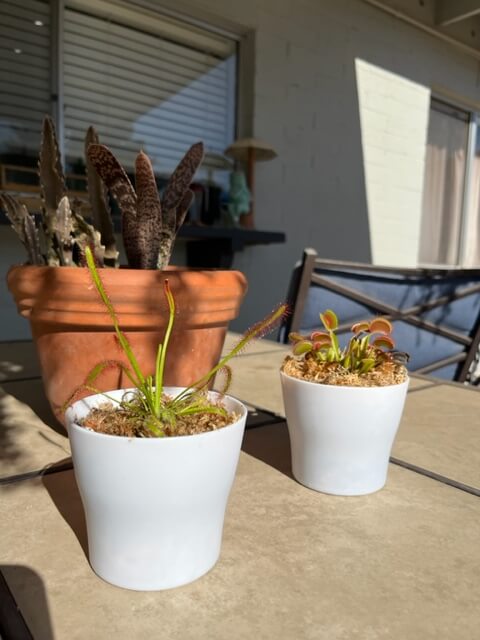
There are a few situations in which you should repot your sundew.
First, if you just purchased a sundew that arrived bare root, you’ll need to pot it yourself. For example, I purchased my Drosera capensis online, and the plant arrived in great condition. It was shipped bare root with sphagnum moss and came with growing instructions.
I potted it right away in a plastic pot (use resin or plastic — ceramic and terra-cotta pots leach minerals into the soil, which can be unhealthy for carnivorous plants) and gave it water. It soaked that up immediately and is doing great.
Second, if your sundew arrived in a pot, look at the soil mix. It’s best to repot if regular soil or dirt was used — sundews need a mix of perlite and sphagnum moss.
Third, if you’ve already had a sundew for some time, you may need to repot it eventually. Sundews typically need to be repotted every three to four years. The best time to repot them is in the early spring, just as they start growing.
Another reason to repot is if the plant has become too large for its current pot or if it has produced many offsets that could benefit from being divided and planted separately. Additionally, if the plant’s health seems to be declining due to nutrient buildup in the old soil, it may be beneficial to repot it.
When repotting, it’s important to handle the plant gently to avoid damaging its sensitive roots. You should use a suitable soil mix, such as a blend of sphagnum peat moss, sand, and perlite (you can also buy a great carnivorous plant mix on Amazon), and ensure the new pot has good drainage.
I hope this guide has helped you feel more confident that you can not only keep your sundew alive but thriving. Leave any specific care questions you have in the comments below. Good luck!
Frequently Asked Questions
What does the Cape Sundew eat?
Cape sundews are carnivorous plants that eat small insects like flies, gnats, moths, spiders, and mosquitoes. They use their sticky, dew-covered tendrils to trap and digest these insects for nutrients. You can also feed them fish flakes and Maxsea to supplement their diet if they aren’t catching insects on their own.
Are Cape sundews invasive?
Cape sundews are not typically considered invasive but can spread if favorable conditions are favorable. However, they’re often grown as houseplants and pose little threat to native ecosystems.
Do Cape sundews like full sun?
Yes, Cape sundews thrive in bright sunlight. They require at least six hours of sunlight each day. However, if temperatures go past 85 degrees Fahrenheit on a regular basis, you should move your plant indoors and ensure it gets enough light from a window or a grow light.
Can sundews eat dead bugs?
Yes, sundews can eat dead bugs. The traps of sundews work differently from those of Venus flytraps. It is not necessary for the prey to simulate being alive to trigger digestion. When a dead bug comes into contact with the sticky dew on the sundew’s tendrils, it can stimulate digestion.